What I read says much about what I think. Much more than what I write.
September 2025
La fornace, by Thomas Bernhard
It gave me a sense of urgency to do things. Writing down my ideas is also a way to stop thinking them, to move beyond. The incessant prose, without paragraphs, without chapters, without breaks between one concept and another resembles life. A senseless journey that leads where you wanted to go. The mistake is discovered only afterward. Perhaps the book that started this practice of keeping track of the books I read, the notes I take while reading them, the spatial and temporal connections that make me move from one book to another.
La patafisica è l'arte del vedere, by Jean Baudrillard
It made me want to reread the Supermaschio by Jarry
With this book I understand why philosophers are accused of saying a lot without making anything clear. The language is deliberately difficult, with lexical constructions at the edge of comprehension.
However the underlying theme is interesting.
The disappearance of illusion through an excess of reality. The immediacy of live transmission, the subjective nature of images, the personalization of remote viewing, all of this leads to the death of illusion.
Today we see everything through a screen that amplifies and filters, through the technique of the microscope or reportage, there is no more room for dream, illusion is here the awareness that reality is nothing but a recent construction, the world forced to be real loses its illusory part. But beneath the veil of truth, the veil of maya torn, there is nothing, only another veil to infinity.
It's like an orgy in which the question "what do you do after the orgy", which implies the desire to go do something interesting after fulfilling the basic function of mechanical pleasure, no longer makes sense because there is no after. The process of mechanical happiness replicates infinitely emptying itself of meaning.
Punacci, storia di una capra nera, by Perumal Murugan
Indian magical realism? Perhaps.
Unexpected book, found on the shelves of a free exchange, chosen for the title and the cover, a sort of geometric minimalism with the eye of a goat in extreme close-up.
The novel comes from India, it speaks of very poor people, once we would have said agricultural sub-proletariat, it speaks of magic and religious beliefs, it speaks of relationships between people near and far, it speaks of the love of the young and the old.
All of this from the point of view of Punacci, the black goat.
Indian magical realism? Perhaps. Certainly a glimpse into lives on the margins, told with sweetness. There's no lack of fierce disillusionment of the weak toward power.
Pianoforte vendesi, by Andrea Vitali.
Fairly disposable book.
A pickpocket thief, the night of the party, it rains and everyone is home. He enters a house, where only a piano for sale remains and the story of ghosts begins, a bit pink a bit police thriller. With inadequate carabinieri and mask characters, without depth.
The style is pleasant and you arrive with pleasure at the end, but it's like when the bus that takes you to work is on time and you find a seat. It's nice, but it's not a journey that leaves a mark.
Perfide, by Giulia Volpi Mannipieri, stage name Mura
The style is wonderful, sublime, d'Annunzian
Stories of love and flirtation in high aristocracy at the turn of the century. At the time it caused scandal, today we are too accustomed to this exquisite delicacy to have it turn our stomachs.
The fact that it was written by a woman adds a level of interest, though not necessarily of truth, to what is written.
The style is wonderful, sublime, d'Annunzian; the reading is at times exciting. Unfortunately stories of love between celebrities, at least for me, have grown tiresome.
il Supermaschio, by Alfred Jarry
Driving humanity, at 300 per hour, on a bicycle.
I would translate "L'oltremaschio" the title of this novel. In French the Nietzschean overman translates as surhomme. With this in mind it's easier to read the work. Andre Murciel is not a superman, he is a man who has moved beyond the steam engine phase and drives humanity toward a new destiny.
 It gave me a sense of urgency to do things. Writing down my ideas is also a way to stop thinking them, to move beyond. The incessant prose, without paragraphs, without chapters, without breaks between one concept and another resembles life. A senseless journey that leads where you wanted to go. The mistake is discovered only afterward. Perhaps the book that started this practice of keeping track of the books I read, the notes I take while reading them, the spatial and temporal connections that make me move from one book to another.
 With this book I understand why philosophers are accused of saying a lot without making anything clear. The language is deliberately difficult, with lexical constructions at the edge of comprehension.
 A pickpocket thief, the night of the party, it rains and everyone is home. He enters a house, where only a piano for sale remains and the story of ghosts begins, a bit pink a bit police thriller. With inadequate carabinieri and mask characters, without depth.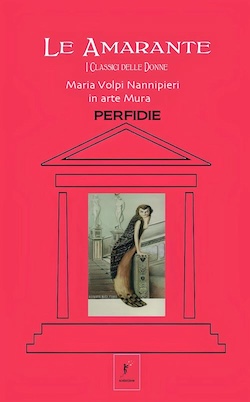
 I would translate "L'oltremaschio" the title of this novel. In French the Nietzschean overman translates as surhomme. With this in mind it's easier to read the work. Andre Murciel is not a superman, he is a man who has moved beyond the steam engine phase and drives humanity toward a new destiny.